 Loading

 Copper closed higher for a fifth consecutive session on Monday, returning close to the record high reached on September 10. The metal was supported by signs of growing supply scarcity in China, the rapid tightening of effective availability in London Metal Exchange warehouses and the recovery in equity markets.
The Comex contract for December delivery rose in New York to $6.8410 per pound, its highest level since September 10, with a maximum intraday gain of 3.3%. Around midday, the contract was trading at $6.7770 per pound, equivalent to around $14,940 per tonne, up by 1.3% from the previous close.
London Metal Exchange three-month copper also recovered, reaching $14,710.50 per tonne before retreating toward $14,650. Both markets therefore returned close to the all-time high of $14,875 per tonne recorded on September 10.
| Indicator | Value |
|---|---|
| Comex December, intraday high | $6.8410/lb |
| Comex December, midday | $6.7770/lb, around $14,940/t |
| Daily Comex change | +1.3%, after a maximum of +3.3% |
| LME three-month copper, high | $14,710.50/t |
| LME three-month copper, subsequent value | Around $14,650/t |
| September 10 record high | $14,875/t |
| Performance since the beginning of 2026 | +20% |
| Distance from the record | Less than 2% |
Eleven Positive Weeks Out Of Twelve
Copper had ended Friday with its 11th positive week out of the past 12, confirming the strength of a movement that has pushed the price up by 20% since the beginning of 2026.
The rally had been temporarily interrupted after the September 10 high. The correction had been triggered by doubts over the timing of possible US tariffs on refined copper and the restrictive tone adopted by the Federal Reserve.
The US central bank raised its benchmark rate by a quarter of a percentage point last week, carrying out its first increase since July 2023, and warned that further increases could follow.
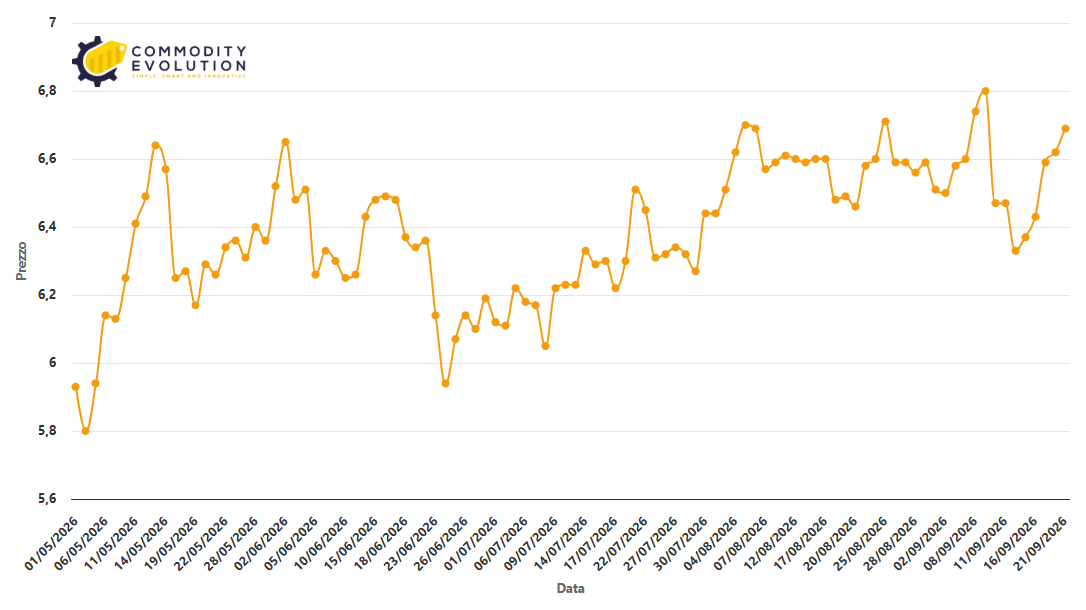
3M CME Copper – US $/lb – Powered by Commodity Evolution
Higher rates tend to restrain economic activity, increase the cost of credit and reduce demand for industrial commodities. Copper’s initial reaction therefore reflected fears that tighter monetary policy could weaken consumption.
The return of buying activity shows, however, that at least in the short term, physical supply tensions are prevailing over macroeconomic risks.
Investors Return To The Market
Funds had reduced their net long positions in Comex copper during the week ending September 15, while the outlook for potential US tariffs remained uncertain.
According to Ole Hansen of Saxo Bank, speculative buying subsequently returned, supported by expectations that Chinese fabricators will rebuild stocks before the national holidays.
China will celebrate the Mid-Autumn Festival from September 25 and the National Day holiday from October 1 to 7. Interruptions in activity can prompt industrial consumers to bring purchases forward to avoid material shortages during the holiday period.
The prospect of restocking strengthened sentiment precisely as the Chinese physical market showed increasingly evident signs of tightness.
China Pays An Increasingly High Premium
The most immediate signal comes from the Yangshan premium, the additional amount paid over LME prices for copper delivered to China’s main import hub near Shanghai.
The premium ended last week at $124 per tonne, its highest level in almost four years, before easing slightly to $119 on Monday.
A high premium indicates that Chinese buyers are willing to pay more to secure physical metal. This willingness reflects greater competition for immediately usable units and signals that domestic supply is not sufficient to fully satisfy demand.
The tightness may not ease before the end of the year. Several Chinese refineries have scheduled maintenance in October and November, according to Shanghai Metals Market, limiting the possibility of a rapid increase in domestic production.
Port congestion in Shanghai is further complicating the picture, making it difficult to assess precisely how quickly imported cargoes can be unloaded and released into the market.
The London Metal Exchange Moves Into Backwardation
The clearest sign of scarcity comes from the London Metal Exchange’s forward price structure. Cash copper is now trading at a premium of $26 per tonne to the three-month contract.
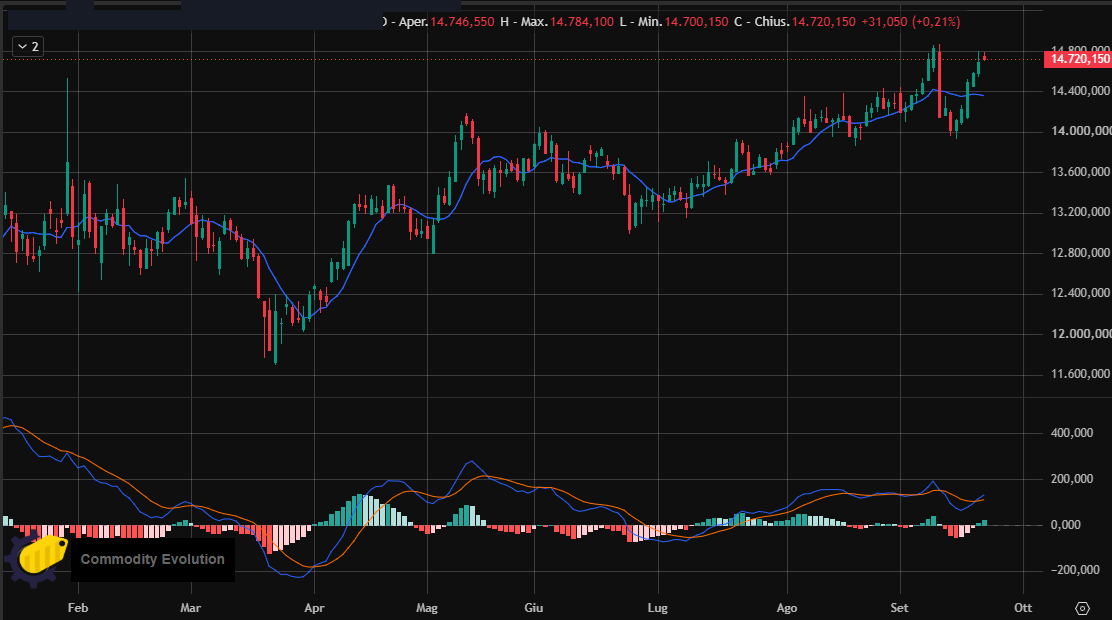
LME Copper – 3-mont $/tonne daily
Only one week earlier, immediately available metal was trading at a discount of $86 per tonne to the three-month contract. The market therefore moved rapidly from contango to backwardation.
Backwardation indicates that buyers place a higher value on copper available today than on metal deliverable in three months. In other words, some users cannot wait and are prepared to pay a premium to obtain the material immediately.
| Availability Indicator | Value |
|---|---|
| LME cash premium over the three-month contract | +$26/t |
| Structure one week earlier | Discount of $86/t |
| Total stocks in LME warehouses | 255,900 t |
| Cancelled warrants | 115,450 t, equivalent to 45% |
| Additional cancellations in Asia | 9,600 t |
| Metal effectively available on the LME | 133,725 t |
| Stocks in Comex warehouses | 696,204 t |
| Comex share of exchange-monitored stocks | 69% |
| Weekly change in Comex stocks | −65 t |
| Copper expected in the United States between September and October | Around 100,000 t |
Almost Half Of LME Stocks Are Already Booked
On Monday, warehouses registered with the London Metal Exchange held a total of 255,900 tonnes of copper. Of this amount, 115,450 tonnes, equivalent to 45%, were under cancelled warrants, meaning that they had already been booked for withdrawal.
The figure includes an additional cancellation of 9,600 tonnes in Asia. Metal effectively available to the market therefore fell to 133,725 tonnes.
The distinction between total stocks and effective availability is essential. Copper physically present in warehouses but already intended for withdrawal cannot be considered freely available to new buyers.
The sharp increase in cancelled warrants therefore indicates that scarcity concerns not only expectations but is translating into an effective removal of metal from the LME system.
The United States Has Accumulated The World’s Copper
The US situation is the opposite. Comex warehouses hold 696,204 tonnes of copper, equivalent to around 69% of all metal monitored by the leading exchanges.
The enormous concentration is the result of importers rushing to move copper into the United States ahead of tariffs that Washington has not yet introduced. The price differential had made it profitable to direct material toward the US market, diverting it from other regions.
This accumulation phase appears to be approaching its limit, however. According to The Copper Journal, Comex stocks fell by 65 tonnes in the latest week, marking the first weekly decline since April.
The reduction is minimal in absolute terms but represents a possible turning point. The fact that stocks have stopped rising suggests that the United States’ ability to absorb new metal is being exhausted.
The Comex Premium Narrows
Another signal comes from the differential between Comex and LME spot prices. During September, the US premium narrowed to around 1.6 cents per pound, its lowest level since April.
The compression of the spread reduces the economic incentive to ship copper to the United States. If the premium does not cover transportation, financing, insurance and handling, new flows become less attractive.
The decline in the US price advantage could help rebalance international flows, making more metal available again for Europe and Asia.
The process will not be immediate, however. Much of the storage capacity at the Port of New Orleans, the main Comex delivery hub, is already occupied.
In addition, around 100,000 tonnes of copper from Africa and South America are expected in the United States between September and October. With new cargoes arriving and limited space, the US market is rapidly running out of capacity to absorb additional material.
Oil And Equities Favor The Recovery
The macroeconomic environment also supported copper on Monday. Oil declined on hopes of a diplomatic solution to the war with Iran, easing fears that crude prices near $100 per barrel could slow the global economy.
Lower energy prices reduced concerns about inflation and industrial costs, helping to improve risk appetite.
Equity markets also rallied ahead of this week’s scheduled summit between US President Donald Trump and Chinese President Xi Jinping.
The combination of positive equity markets, lower oil prices and expectations of dialogue between Washington and Beijing created a favorable environment for copper purchases.
Mining Equities Follow Copper But Remain In The Red
Shares in producing companies followed the metal higher in Monday’s session. The sector nevertheless remains firmly negative in September, following the correction that began around copper’s September 10 record.
| Company | Monday’s Movement | Market Capitalization | September Performance |
|---|---|---|---|
| Freeport-McMoRan | +0.6% | $103.3 bln | −5.0% |
| Southern Copper | +0.7% | $166.3 bln | −5.7% |
| Rio Tinto | — | $165.2 bln | — |
| First Quantum Minerals | +2.5% | $26.4 bln | — |
| Lundin Mining | +2.1% | $20.8 bln | −7.7% |
| Ivanhoe Mines | +2.8% | $12.6 bln | — |
| Teck Resources | +1.2% | $32.5 bln | — |
| Anglo American | +2.0% | — | — |
| Capstone Copper | +0.6% | — | −9.4% |
| Luca Mining | More than +8% | — | — |
| Glencore | −3.1% | $84.8 bln | −9.3% |
| BHP | — | $220.5 bln | −8.4% |
| Antofagasta | — | $48.3 bln | −9.5% |
Freeport Recovers, But Grasberg Still Weighs
Freeport-McMoRan, the largest listed copper producer, rose by 0.6% in New York, reaching $71.94 per share and a market capitalization of $103.3 billion. The stock nevertheless remains down by 5% for the month.
The company’s operational problems at the Grasberg mine in Indonesia are being compounded by Ivanhoe Mines’ production reduction at Kamoa-Kakula in the Democratic Republic of Congo.
According to Sprott Asset Management, these disruptions have removed around 600,000 tonnes from expected global supply for the year. The difficulties could also result in 2026 recording the first decline in global mined copper production since 2017.
The risk of a contraction in mined supply reinforces the impact of reduced visible availability in the physical market and helps support prices.
Southern Copper Overtakes Rio Tinto
Southern Copper advanced by 0.7%, reaching a market capitalization of $166.3 billion. The value places the Mexican company just ahead of Rio Tinto, valued at $165.2 billion, in second position in MINING.COM’s ranking of the world’s most valuable mining groups.
Southern Copper had briefly overtaken Rio Tinto in August before falling back. Despite Monday’s recovery, the stock remains down by 5.7% in September.
The market capitalization reflects the increasing importance assigned by the market to companies with strong copper exposure, in a context marked by operational difficulties and expectations of future scarcity.
First Quantum Focuses On Mine Electrification
In Toronto, First Quantum Minerals gained 2.5%, bringing its market value to $26.4 billion.
The company secured a UK patent last week for its trolley-assist haulage system. According to First Quantum, the technology can reduce truck diesel consumption by up to 90% on uphill routes.
The system represents an example of how electrification can reduce the energy costs and emissions of mining operations while improving transport efficiency at mines.
Lundin And Ivanhoe Recover After Revisions
Lundin Mining rose by 2.1%, reaching a market capitalization of $20.8 billion. The stock nevertheless remains down by 7.7% in September, after the company reduced its 2026 guidance.
Ivanhoe Mines gained 2.8%, bringing its market value to $12.6 billion. The company had fallen out of the ranking of the world’s top 50 mining companies following the downgrade to the outlook for Kamoa-Kakula.
The recovery in the two stocks therefore does not erase the impact of production reductions and less favorable guidance, but reflects the sector’s positive reaction to higher copper prices.
Teck Awaits Chinese Approval For The Merger
Teck Resources advanced by 1.2% in New York, reaching a valuation of $32.5 billion. The Canadian company is awaiting approval from Chinese authorities for its $53 billion merger with Anglo American, which was itself up by 2% in US trading.
Glencore, which holds a 44% interest in the Collahuasi mine, is at the center of the possible integration process between that operation and Teck-controlled Quebrada Blanca.
The transaction could generate estimated copper synergies of $1.4 billion per year, but their realization will depend on agreements between the partners and completion of the merger.
Capstone Sells Cozamin, Luca Rises More Than Eight Percent
Capstone Copper gained 0.6% in Toronto after reaching an agreement to sell the Cozamin mine in Mexico to Luca Mining for a maximum potential value of $385 million.
The agreement includes up to $60 million in payments contingent on copper averaging above $7 per pound between 2027 and 2029.
Capstone will focus its activities on Chile and Arizona. The stock remains down by 9.4% for the month, while Luca Mining jumped by more than 8% following the announcement.
The Diversified Majors Remain Weaker
The large diversified mining groups performed worse than companies with a greater concentration on copper.
Glencore’s US-listed shares fell by 3.1% on Monday, reducing the Swiss group’s capitalization to $84.8 billion. The stock has lost 9.3% in September, while the consequences of the company’s dealings with iron ore trader Radiant World continue.
BHP, valued at $220.5 billion, is down by 8.4% for the month. In July, production at the Escondida mine in Chile fell by 22%, adding a new source of concern on the supply side.
Antofagasta has lost 9.5% in London after reducing its 2026 guidance. The company has a market capitalization of $48.3 billion.
The weakness of the large producers reflects the operational difficulties that are simultaneously supporting the price of the metal.
Chile And Zambia Confirm Supply Problems
The problems do not concern individual companies alone. Chilean copper production fell by 9.4% in July, showing a significant contraction in the world’s leading producing country.
State-owned Codelco has also postponed a restructuring plan that could result in a reduction of one fifth of its workforce.
In Zambia, Konkola Copper Mines restarted the Nchanga smelter only on Monday, following a maintenance shutdown that lasted 106 days instead of the 60 initially scheduled.
These delays add to the difficulties at Grasberg, Kamoa-Kakula and Escondida. The succession of disruptions, production revisions and prolonged maintenance reduces the ability of mined and refined supply to respond rapidly to high prices.
Copper Remains Less Than Two Percent Below The Record
Copper has gained 20% since the beginning of 2026 and is trading less than 2% below its all-time high.
The rally is supported by a particularly favorable combination: more aggressive Chinese demand, declining available metal on the LME, mine disruptions and a reduced ability of the United States to continue absorbing global stocks.
The main risks remain US monetary policy, uncertainty over tariffs and the possibility that an economic slowdown could reduce industrial demand. In the short term, however, the market appears focused mainly on immediate availability.
The rapid transformation of the LME curve into backwardation shows that buyers need copper today, not in three months. As long as this urgency remains visible in physical premiums, cancelled warrants and available inventory levels, the September 10 record will remain within the market’s reach.