 Loading

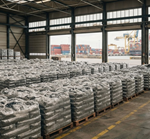 The European manganese metal market continues to move through a phase of substantial immobility. On Wednesday July 22, prices remained unchanged, held back by still-weak demand from steel plants, freight costs that have now stabilized and the limited willingness of European traders to purchase new material from China.
The prevailing feeling among operators is that of a market that has not stopped completely, but is proceeding with extreme caution. Price inquiries are not lacking, and some users are returning to test the market, without however turning their interest into actual orders.
“Customers are still waiting before purchasing,” a trading source explained, summarizing an attitude that has now become widespread among European steel plants.
Unchanged Quotations In Rotterdam
The twice-weekly assessment by Commodity Evolution for 99.7% pure electrolytic manganese flake, material available in Rotterdam warehouses, remained between $2,770 and $2,820 per tonne on Wednesday.
The price range remained unchanged from the previous session, confirming the absence of sufficiently strong pressure to push the market in a clear direction.
Several traders reported receiving new inquiries during the week and submitting offers to interested steel plants. These signals indicate that a certain level of commercial activity is still present, but for the moment it remains confined to the consultation and preliminary negotiation phase.
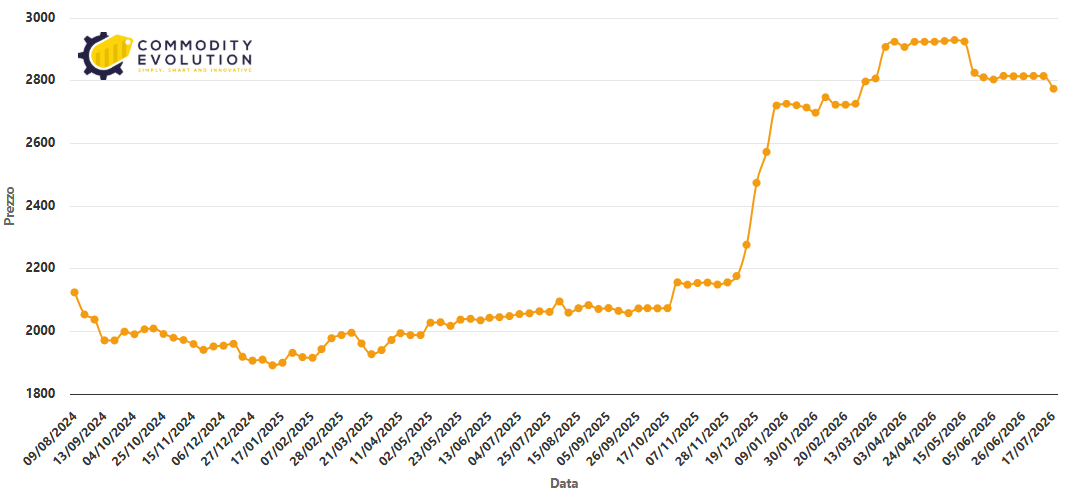
Manganese flake 99.7% min In stock – Rotterdam – Europe $/ton – Powered by Commodity Evolution
“There are still signs of life,” a second operator observed.
Despite this moderate return of interest, none of the traders contacted reported the conclusion of transactions on the spot market. The lack of deals therefore confirms the seasonal slowdown that had already emerged in previous weeks.
The summer period traditionally tends to reduce the activity of European steel plants, due to maintenance programs, lower production capacity utilization and more cautious inventory management. In this context, many buyers prefer to postpone purchases, relying on the possibility of finding more favorable prices or waiting for clearer indications on steel demand after the summer break.
Steel Plants Remain Cautious On Purchases
The weakness of the market does not appear to derive from a complete absence of requirements, but rather from users’ decision to limit purchases to immediate needs.
Steel plants continue to avoid rebuilding inventories in advance, especially at a time when visibility on steel product orders remains limited. Electrolytic manganese, used in the production of special steels and in various alloys, is therefore being purchased predominantly according to a short-term approach.
European traders are also maintaining a cautious position. With material already available in warehouses and demand unable to absorb new tonnage quickly, the incentive to make additional purchases from China remains limited.
This situation is helping to keep the Rotterdam market balanced: on the one hand, weak consumption is preventing an increase in quotations; on the other, the absence of aggressive selling and the stability of logistics costs are for now preventing a significant decline.
Ocean Freight Rates Stabilize
A further element of stability is coming from the transport market. Trading sources reported that shipping costs from the Chinese port of Tianjin to Rotterdam have recently stabilized, after the decline recorded compared with the beginning of July.
One operator indicated freight rates of around $3,500 per container, compared with approximately $4,000 recorded in the first days of the month.
The reduction in logistics costs offers some relief to European importers, but it does not yet appear sufficient to stimulate new purchases. The main issue is not the availability of material or the cost of transportation, but rather the lack of sufficiently solid final demand to justify an increase in inventories.
For many traders, purchasing new quantities from China today would mean taking the risk of keeping the material in storage for longer than expected. In a substantially inactive market, financing and storage costs can rapidly reduce commercial margins, even when purchase prices at origin appear competitive.
Chinese Exports Increased In June
On the supply side, data published on Monday July 20 by China’s General Administration of Customs showed an increase in shipments of manganese metal to the Netherlands.
In June, China exported 5,121 tonnes of manganese metal to the Netherlands, the main entry point for material intended for the European market.
The volume was 975 tonnes higher than the 4,146 tonnes exported in May. The monthly increase was therefore significant, but the June figure nevertheless remained below the annual average, estimated at approximately 6,387 tonnes.
Market operators did not interpret the increase as a sign of particular pressure on European supply. The shipments were described as being consistent with the normal monthly fluctuations in trade flows between China and Rotterdam.
“Chinese exports were normal for June,” a third trading source said.
The increase compared with May could help keep European warehouses well supplied, but it does not appear high enough to cause excessive inventory growth or generate immediate downward pressure on prices.
A Market Waiting For The Autumn Recovery
Overall, the European manganese market appears balanced, but without a clear direction. Quotations remain supported by the stability of supply and logistics costs, while weak demand from steel plants prevents any attempt at an increase.
The inquiries received by traders demonstrate that users continue to monitor the market and that requirements have not disappeared. However, the distance between requesting an offer and concluding an order still remains wide.
In the short term, the most likely scenario is therefore a continuation of stability, with any fluctuations remaining limited within the current price range. A clearer change could emerge only with the return of buyers after the summer break, when it will be possible to assess more accurately the level of European steel production and the actual need to rebuild inventories.
Until then, Rotterdam will probably continue to record a quiet but not completely inactive market, in which sellers and buyers prefer to observe the other side’s moves before taking new positions.