 Loading

Update to May 28 – Industrial metals performance – May 2025
In May, non-ferrous metals showed a positive trend overall, especially when viewed in terms of their price in dollars per ton. Operators’ interest remained high, even in a context still marked by macroeconomic volatility and uncertainties related to Chinese demand.
Among the best-performing commodities in US currency, zinc (+1.79%), copper (+1.74%) and primary aluminum (+1.67%) stood out, all supported by a good balance between supply and demand, as well as constructive expectations on the industrial and infrastructure front. Tin also closed the month in positive territory (+1.34%), partially recovering the losses of the previous weeks.
Lead recorded a modest +0.51%, while secondary aluminum remained unchanged. The only metal to close May in negative territory was nickel (-0.68%), penalized by the persistent oversupply and the weakness of demand in the stainless steel sector, especially in Asia.
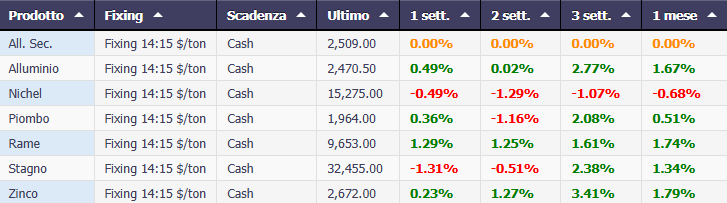
Performance Metals Cash $/ton – Powered by Commodity Evolution
If we look at the same prices in euros per tonne, the picture remains similar but slightly more muted. The exchange rate effect – with a stronger euro – has in fact reduced the gains in local currency. In this case too, zinc, copper and aluminium lead the monthly ranking, with increases of 1.78%, 1.73% and 1.65% respectively. Lead and tin remain in positive territory, while nickel and secondary aluminium close slightly down.
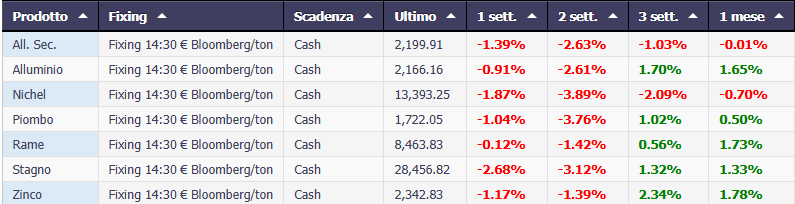
Performance Metals Cash €/ton Bloomberg – Powered by Commodity Evolution
Global Ferrous Scrap Market Between Strategic Reorganizations and Geopolitical Volatility
In an increasingly fragmented and unstable context, the global ferrous scrap market reflects with increasing intensity the complex interactions between industrial demand, protectionist policies and regional logistics dynamics.
Recent data from the Bureau of International Recycling (BIR) provide a multilevel interpretation of how these elements are redrawing the geographies of trade, prices and supply strategies.
Differentiated Demand: Selective Growth and Industrial Slowdown
According to the BIR, demand remains the main driver of prices, but with strong divergences on a geographical scale. Some economies — driven by infrastructure projects, energy transition and stable industrial policies — maintaining high levels of scrap absorption. In other regions, however, a sharp contraction in demand is observed, due to:
- The global manufacturing slowdown;
- Geopolitical and regulatory instability;
- Production reconfigurations in the steel sector.
These asymmetries are also reflected in trade flows: while some emerging countries are stepping up actions for industrial food expansion, others are drastically cutting purchases due to abundant domestic supply and weak demand.
United States: Between Spring Euphoria and Duty Shock
In the second quarter of 2025, the US market experienced a strong cyclical discontinuity. In April, thanks to improved weather conditions and an initial increase in prices, there was a recovery in flows to collection centers and an acceleration of internal trade and with regional partners.
But this momentum was abruptly interrupted due to the new duties imposed by the Trump administration, which particularly affected exports to Mexico. The effects were not long in coming:
- Almost total blockage of flows from the Southern States to Mexico;
- Internal surpluses of premium quality scrap (such as P&S – Plate & Structural);
- Pressure on prices and generalized reductions in May offers.
American traders had to adapt quickly, cutting price lists to avoid the accumulation of sold stocks and remain competitive on the domestic market.
Europe Between Precautionary Accumulation and Defensive Strategy
In the United Kingdom, as in other areas of Western Europe, the scrap recycling sector is in a phase of low operations and high caution. Incoming flows at collection centers are unstable, and many plants — especially shredding and selection plants — are contributing below the economic efficiency threshold.
There are many causes:
- Macroeconomic uncertainty;
- Difficulty in planning regular supply flows;
- Price volatility and trade policies still in evolution.
In response, many European operators have adopted voluntary accumulation strategies, betting on a future price recovery. This trend on the one hand mitigates the pressure on spot prices, but on the other signals a lack of confidence in the stability of the market in the short term.
Turkey Cools Down, But South Asia Picks Up
Traditionally the world’s leading importer of scrap, Turkey recorded a sharp drop in import prices in April, resulting in a reduction in purchased volumes. This downsizing has had a domino effect on European suppliers, who have been forced to look for alternative markets.
The answer has come in the form of a logistical repositioning: exports have been diverted to India and Pakistan, where:
- Containerized transport costs are down;
- Local processors’ interest in mixed and pressed scrap is increasing;
- Temporarily weaker competition from Turkey is encouraging the entry of new material.
This reorientation has led to a regionalization of scrap markets, with the emergence of new Eurasian routes and more fragmented, but also more dynamic, competition between Europe, the Middle East and South Asia.
China on the Front Line: Record Steel Exports and Scrap Pressures
In the first quarter of 2025, China exported 27.43 million tonnes of steel, reaching the highest level since 2016. This export boom is rewriting the regional balance, with direct and indirect impacts on the scrap market:
- Asian producers are reducing domestic electricity production, lowering scrap demand;
- Chinese steel is displacing domestic steel in neighboring countries, depressing secondary raw material demand;
- Scrap prices in East Asia are experiencing prolonged compression, amid oversupply and growing competition.
This is putting pressure on regional processors, who are being forced to reduce scrap input and review their sourcing strategies.
Taiwan Restructures: Scrap Down, Billets and Pig Iron Up
A prime example of strategic adaptation to new market conditions is Taiwan, where major steel producers are reviewing their raw material mix. In the first three months of 2025, there was a significant decline in scrap imports, offset by an increase in the use of:
- Imported billets, often from countries with more stable integrated supply chains;
- Pig iron, as a more controllable alternative in terms of chemistry and logistics;
- Local scrap, preferred for greater immediate availability and lower handling costs.
This restructuring reflects a broader trend: reducing exposure to global scrap volatility and focusing on more predictable supplies to ensure production continuity and economic stability.
Japan in Contraction: Between Strong Yen and Depressed Export Demand
Japan, one of the main scrap exporters in the Asian region, is also showing signs of growing difficulty. Since mid-April 2025, the market has entered a phase of structural cooling, due to a combination of factors:
- Global macroeconomic concerns, which are holding back investments;
- Reduced demand from Southeast Asian markets, due to Chinese competition;
- Appreciation of the yen, which penalizes the competitiveness of Japanese scrap in dollars.
The result is a significant reduction in exports, which has had a domino effect on the entire local scrap treatment and preparation chain. Japanese operators, faced with compressed margins and uncertain prospects, prefer to postpone sales, contributing to a climate of wait-and-see and caution.
Conclusions: Global Ferrous Scrap in a Multipolar Transition Phase
The second quarter of 2025 represents a complex but strategically relevant transition phase for the ferrous scrap market. The convergence of protectionism, logistics, political tensions and industrial reconfigurations is redrawing the power structures and global trade routes.
The main signs of change include:
- The redefinition of the balance between the US, Mexico and Asia;
- The temporary reduction of Turkey’s role as a central hub;
- The logistics rise of South Asia;
- China’s expansion as a low-cost steel exporter;
- The strategic adaptation of regional players (such as Taiwan and Japan).
In this scenario, flexibility, analytical capacity and speed of execution will be the main levers to remain competitive. Traders, recyclers and producers will have to be able to pick up weak signals, adapt to logistical fragmentations and redefine their supply and sales channels with a multipolar view of risk.
Commodity Evolution is the ideal solution to support the budgeting and negotiation activities of the corporate purchasing department.
Access to the platform will allow you to view real-time prices and a lot of information relating to the metal, steel, scrap market and many other reference sectors at any time, with more than 1,500 reference products.
Request a free one-week Demo of our platform without obligation
Disclaimer
This document was drafted by Commodity Evolution. This document is intended for consultation by the subjects to whom it is addressed, and, in any case, is not intended to replace the personal judgment of the subjects to whom it is addressed. Although Commodity Evolution takes the utmost care in preparing this document and considers its contents to be reliable, it does not assume any responsibility for the accuracy, completeness and timeliness of the data and information contained or present on the resources and data used for the purposes of its preparation. Consequently, Commodity Evolution declines all responsibility for errors or omissions. The opinions, forecasts or estimates contained in this document are made exclusively as of the date of preparation of this document, and there is no guarantee that future results or any other future events will be consistent with the opinions, forecasts or estimates contained herein. Any information contained in this document may, after the date of preparation of the same, be subject to any changes or updates, without any obligation to communicate such changes or updates to those to whom this document has previously been distributed. This publication is provided to you for information and illustration purposes only, and does not constitute in any case an offer to the public of financial products or promotion of investment services and/or activities either towards persons resident in Italy or towards persons resident in other jurisdictions. Commodity Evolution, nor any of its directors, representatives or employees assume any type of liability, in whole or in part, for damages (including, but not limited to, damages for loss or loss of profits, business interruption, loss of information or other economic losses of any nature) arising from the use, in any form and for any purpose, of the data and information present in this document.