 Loading


Many U.S. importers, exporters and companies can breathe a sigh of relief, albeit temporary, after learning that President Trump’s planned reciprocal tariffs will not be introduced this week.
However, uncertainty remains high, and the world of international trade continues to be rocked by possible impending changes.
A Memorandum to Study Reciprocal Tariffs
On Thursday, President Trump signed a memorandum instructing federal agencies to conduct investigations and develop a detailed plan for the introduction of reciprocal tariffs against those countries that impose tariffs on U.S. exports or create barriers to American business and trade.
However, the memo states that such investigations will begin only after the agencies submit their reports on the state of U.S. trade, which Trump himself requested on the day of his inauguration with the “America First Trade Policy” memo.
These reports, which could include support for the president’s proposal for a 60 percent tariff on all Chinese goods, must be submitted by April 1. Only then can decisions on reciprocal tariffs be made.
Some experts believe that this time frame may allow U.S. trading partners to reduce their tariffs, thus avoiding reciprocal measures by Washington.
The Impact on Global Trade and the Transfer of Supply Chains
Despite the temporary suspension of the tariff increase, the mere fear of these changes is already affecting global trade
In particular, the United States is accelerating the shift of its sources of supply away from targeted countries such as China. At the same time, shippers are anticipating orders from nations that may soon be hit by tariff increases, such as Mexico.
The Effect on Maritime Transportation: High Volumes and Tariffs
In the U.S. shipping industry, this supply rush is evident in the volumes of containers imported from the presidential election to date, as well as in the forecast for the coming months.
Shipping rates remain high despite the traditional off-season for the transpacific container market. Currently, costs stand at around $4,760 per 40-foot container (FEU) for the West Coast and $6,400 for the East Coast.
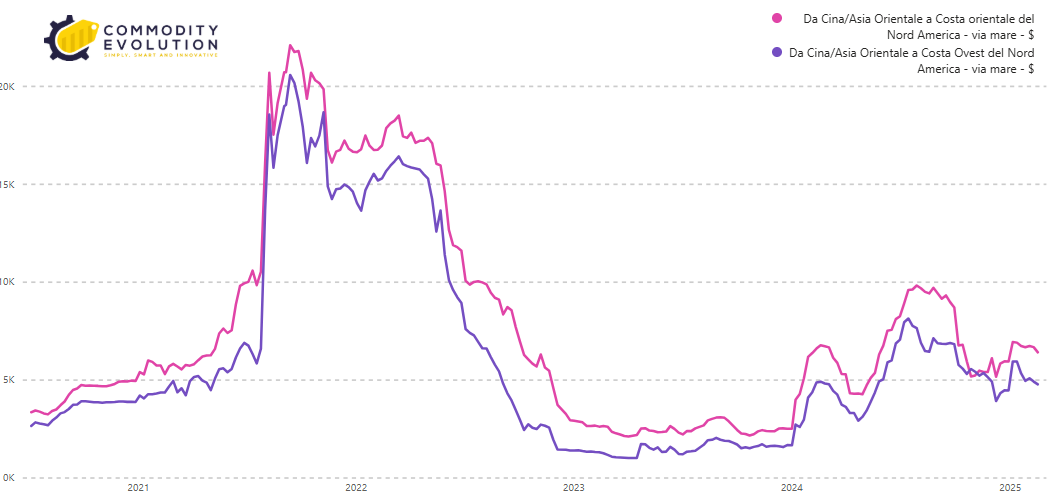
Asia-U.S. Sea Freight Rates – $/FEU – Powered by Commodity Evolution
Without these tariff factors, costs for Asia-Europe and Asia-Mediterranean transport are falling more significantly than the transpacific route, especially after the Lunar New Year, as a result of reduced demand.
Asia-Europe tariffs have fallen nearly 45 percent since the beginning of January, reaching $3,160 per FEU, the lowest level since the onset of the Red Sea crisis. For the Mediterranean, tariffs are approaching $4,450 per FEU.
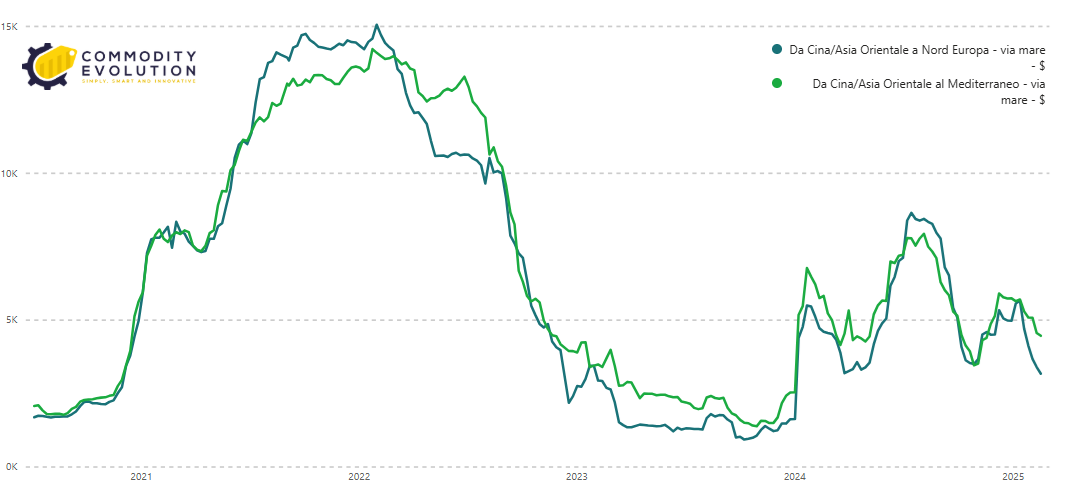
Asia-Europe Sea Freight Rates – $/FEU – Powered by Commodity Evolution
To counter this decline, carriers are increasing cancellations of scheduled departures (blanked sailings) and have announced general rate increases (GRIs) starting March 1 for about $1,000 per FEU. However, there is skepticism that these increases will be successful.
Impact on Air Transport: The End of De Minimis for Chinese Imports
The air transport market is also being affected by trade policies. Earlier this month, President Trump suspended and then quickly reinstated the eligibility of Chinese e-commerce imports for “de minimis” regulations, which allow low-value goods to enter the United States without tariffs.
Chinese e-commerce giants such as Temu and Shein rely heavily on this exemption to quickly and cheaply ship products directly to U.S. consumers via air freight.
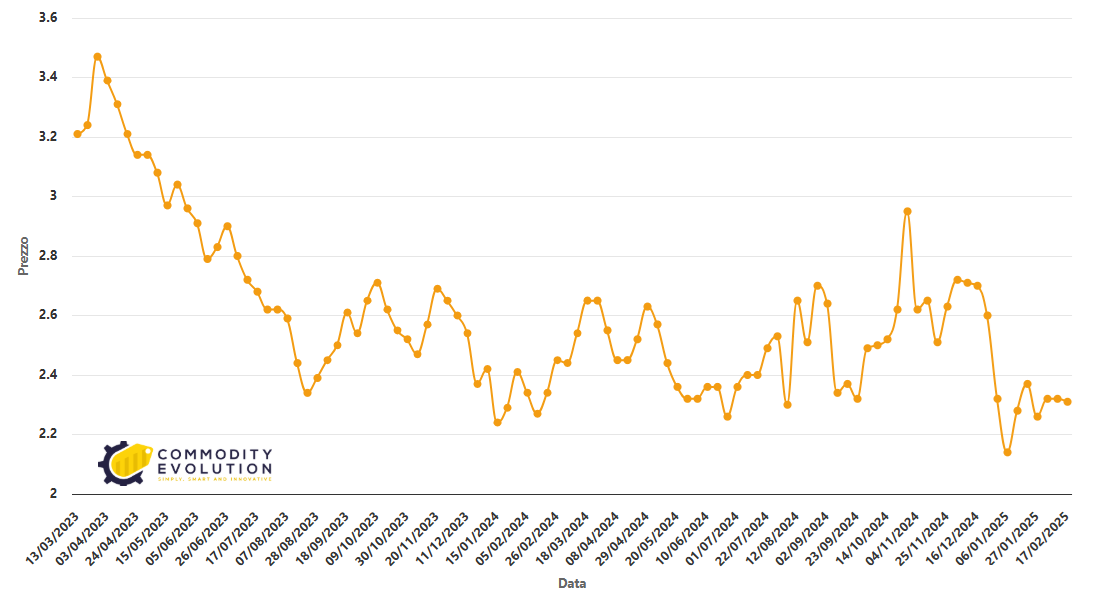
Global Air Freight Index $/100-3000kg – Powered by Commodity Evolution
The possible elimination of de minimis regulations could drastically reduce the influx of e-commerce goods into the United States transported by air, resulting in longer delivery times and price increases of up to 50 percent for products that continue to be shipped this way.
Chinese Platforms’ Adaptation Strategies
Temu and Shein were already preparing to reduce their reliance on de minimis regulations and airfreight.
More than one-third of Temu’s U.S. orders already come from vendors with U.S.-based inventories. However, these platforms are now accelerating adaptation plans, raising prices, pushing sellers to build inventories in the U.S., and incentivizing the shift of production to Vietnam and other alternative countries to China.
The temporary suspension of de minimis regulations for Chinese goods was motivated by the need to allow U.S. Customs and Border Protection to prepare for an increase in formal customs declarations. However, this postponement could also give time for a gradual reduction in air e-commerce import volumes, avoiding an abrupt impact on the industry.
Future Outlook for the Air Market
There are already reports of e-commerce companies canceling cargo flights. Although airfares between China and the United States have not yet collapsed, data show a drop below $5 per kilogram for the first time since last August, down 7 percent from the previous week.
Normally, prices tend to rise immediately after the Lunar New Year, but this drop could suggest a downward trend in airfares until the final elimination of the de minimis regulation, with further sharp price declines once the change takes effect.
The evolution of U.S. tariff policies remains a major determinant of global trade and transportation, with immediate and long-term effects that could reshape the dynamics of international supply chains.