 Loading

 Metals: Prices and Scenarios — Commodity Evolution’s Weekly Market Briefing Issue 6 | 5 November 2026
Aluminium prices recover and a supplier offers an earlier delivery. For procurement, the benefit depends on the cost of holding material before it is needed: tied-up capital, storage and additional charges can absorb part of the expected price saving.
The practical question is: how much would the price have to rise for an early purchase to pay off? A hypothetical customer case provides a threshold to compare with the company’s scenarios.
The Market Recovers, While Requirements Have Their Own Timing
Commodity Evolution’s chart shows aluminium in euros per tonne from August through 4 November. After a high near €2,920/t in the first half of August, the series falls towards €2,675/t in October and recovers to around €2,785/t in its latest observation, approximately €110/t above the recent low.
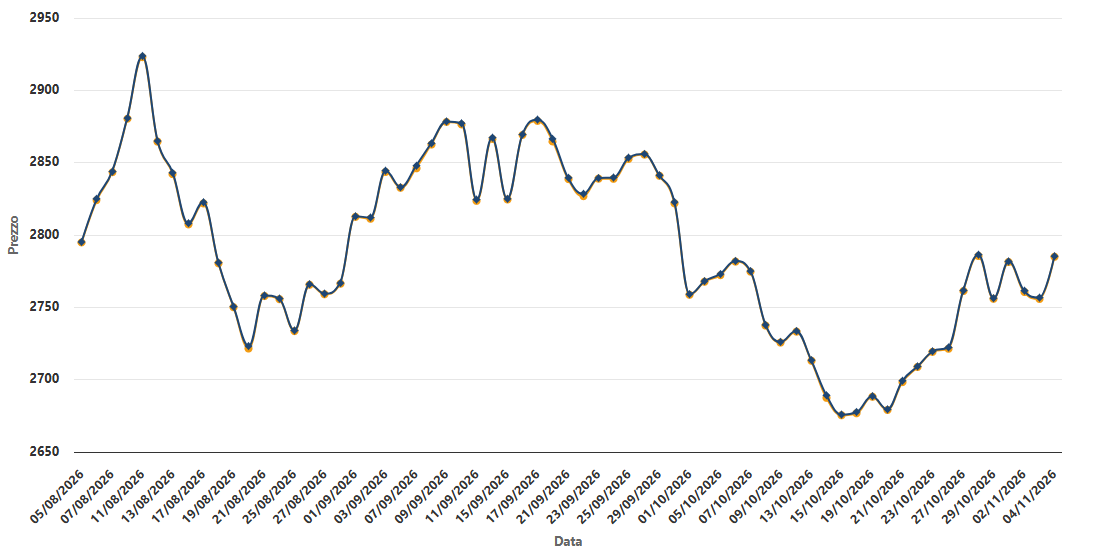
LME Aluminum – Cash euro/ton – Powered by Commodity Evolution
The Case: 50 Tonnes Needed In Three Months
A processing company expects to use 50 tonnes of aluminium for a confirmed production order starting in 90 days. The requirement is established but the price remains open. Procurement considers receiving and paying for all the material today or purchasing it when needed, assuming equivalent availability.
The illustrative supply cost is €3,000/t: a €2,785/t metal component rounded from the chart, plus €215/t for premium, logistics and other items. Those additional supply components remain unchanged between the two alternatives. The early payment is €150,000.
Entirely hypothetical case. All 50 tonnes are held for 90 days without intermediate consumption. Payment is due on delivery in both alternatives. Figures exclude VAT and tax effects. The capital cost is an assumed company input, not an observed market interest rate.
What Does Early Inventory Cost?
| Incremental Cost | Assumption And Calculation | Amount |
|---|---|---|
| Tied-up capital | €150,000 × 6% per year × 90/360 | €2,250 |
| Additional storage and handling | €8/t per month × 50 t × 3 months | €1,200 |
| Additional insurance | €3/t for the full period × 50 t | €150 |
| Total early-purchase cost | €3,600 / 50 t | €72/t |
The total cost of buying early is therefore €153,600, equivalent to €3,072/t. Only costs caused by bringing the purchase forward are included; existing fixed warehouse costs should not automatically be allocated to this decision.
The Break-Even Threshold Is €3,072 Per Tonne
Under these assumptions, buying early is economically favourable only if the comparable supply cost in 90 days exceeds €3,072/t. This requires an increase of more than €72/t, or 2.4% above the initial €3,000/t.
| Hypothetical Cost In 90 Days | Cost Of Buying When Needed | Net Benefit Of Buying Early |
|---|---|---|
| €2,900/t | €145,000 | −€8,600 |
| €3,000/t | €150,000 | −€3,600 |
| €3,072/t | €153,600 | €0 |
| €3,150/t | €157,500 | +€3,900 |
Illustrative scenarios with no assigned probabilities. A negative value means buying early costs more. The threshold is a result of the example, not an aluminium price forecast.
Checks Before Making The Decision
Procurement should confirm quantities and consumption dates: a delayed production order extends the holding period. Finance should validate the capital cost, while logistics confirms incremental charges and avoids overlaps between storage and insurance.
A third quotation may be useful: fixing today’s price with deferred delivery. Include any additional charges, deposits and volume commitments in the comparison. If material availability differs, the risk of non-delivery also needs a separate assessment.
Commodity Evolution provides quotations and historical series for price comparisons; whether an early purchase pays off then depends on the company’s costs and requirements. Before increasing inventory, do you know the minimum price rise needed to cover the cost of buying early?