 Loading

 Metals: Prices and Market Outlook — Commodity Evolution’s Weekly Monitor, Issue No. 2 | October 8, 2026
“Scrap prices have risen; we need to adjust the price of steel.”
For steel product buyers, this explanation raises a practical question: how much of the requested price hike is attributable to the raw material, and how much depends on other cost components?
Ferrous scrap is a key raw material used to produce rebar in electric arc furnace steel mills; it is melted down, cast into billets, and subsequently rolled. Consequently, its price impacts the production cost of rebar, alongside energy and processing costs.
Commodity Evolution’s charts regarding the Turkish market offer an interesting case study. Following a period of summer weakness, both scrap and rebar prices have recovered. However, the finished product has seen a sharper increase—both in percentage terms and in euros per tonne.
Scrap recovers from summer slump
The LME TSI HMS 80/20 Steel Scrap CFR Turkey series, quoted in euros per tonne, shows levels around €350–355 in May. The benchmark price fell between June and July, reaching approximately €321 in the second half of August.
From September onwards, the trend reversed. This recovery pushed the price above €340 and subsequently past €350, with the latest reading around €351 per tonne.
Compared to the summer low, the increase is approximately €30, or 9%. However, looking at the period as a whole, the price of scrap has essentially returned to the level where it started.
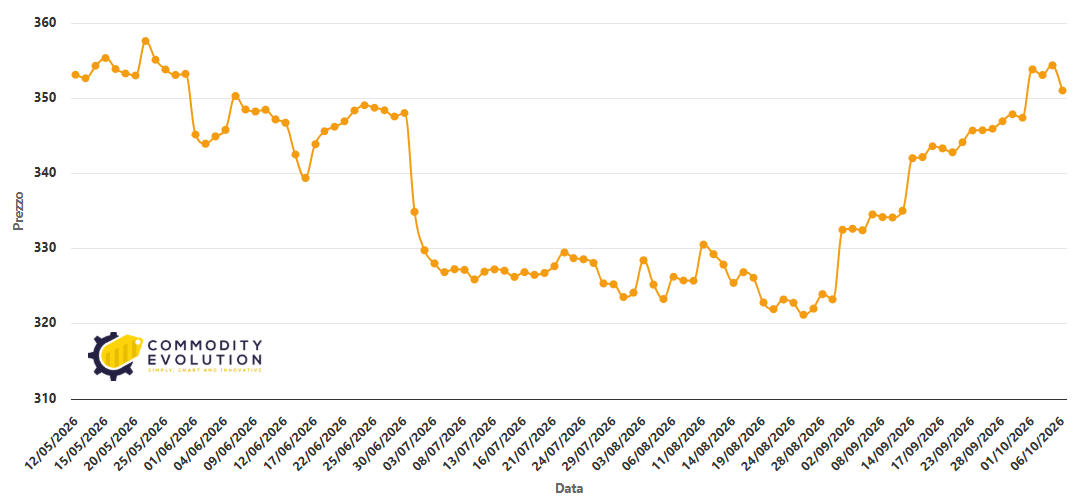
LME Steel Scrap TSI HMS 80-20 CFR – Türkiye – Powered by Commodity Evolution
Rebar prices surpass spring levels
The LME Rebar FOB Turkey series initially follows a similar path: it fluctuates around €510 per tonne between May and June, weakens during the summer, and reaches approximately €494–495 in the second half of August.
The subsequent recovery is more pronounced. In September, the benchmark first rises above €510, then €530, approaching €550 in the initial readings for October.
The final figure shown is around €548–549 per tonne—approximately €54 above the summer lows, representing a recovery of nearly 11%.
Unlike scrap, rebar prices thus rise above the levels seen in May and June. The figures cited are approximate, derived from the charts.
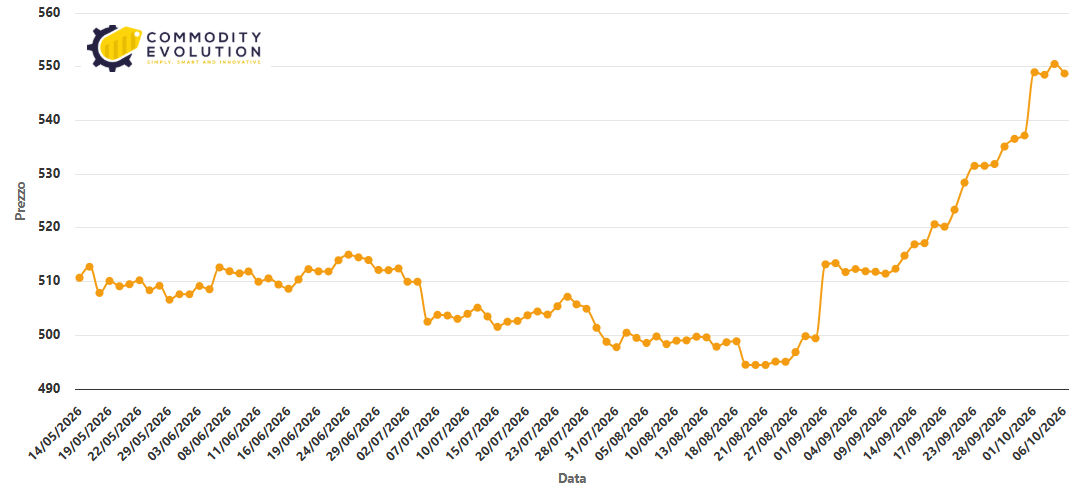
LME steel rebar FOB – Türkiye euro/ton – Powered by Commodity Evolution
Raw material is a component of the price.
The comparison shows that the two series move in the same direction, but with varying intensity. On its own, it does not allow one to determine how much of the rise in rebar prices is attributable to scrap.
Reconstructing the cost of the finished product requires taking into account energy consumption, production yield, and other industrial costs. Furthermore, the selling price is influenced by order volumes, material availability, and commercial terms.
The difference between the two price quotes must also be interpreted with caution: it does not directly represent the steel mill’s margin. The scrap price refers to CFR Turkey delivery, whereas rebar is quoted on an FOB Turkey basis; the logistical terms differ, and a tonne of scrap does not convert entirely into a tonne of saleable product.
How can these signals be used in negotiations?
When a supplier justifies a price hike by citing rising scrap costs, it is worth checking the reference period and comparing this against the price trends of the finished product.
The starting point is crucial: both series have risen compared to their August lows; however, compared to May, scrap prices are close to their initial levels, whereas rebar is more expensive.
For buyers in Italy, these benchmarks help interpret the international market. However, comparing a local offer requires aligning factors such as quality, specifications, transport, and delivery terms.
With Commodity Evolution, you can track both raw materials and steel products, consulting price quotes and historical data to support your budgeting and negotiation processes.
What benchmarks do you use to evaluate price increases from your suppliers? Write to me listing the materials you purchase, and I will show you the relevant data series available on the portal.